
Livraison gratuite en Belgique et frais de port réduits à 4,99€ pour la France à partir de 59€ !

Livraison gratuite en Belgique et frais de port réduits à 4,99€ pour la France à partir de 59€ !

Tiny wild bottom catfish, very peaceful, for cool, well-oxygenated aquariums
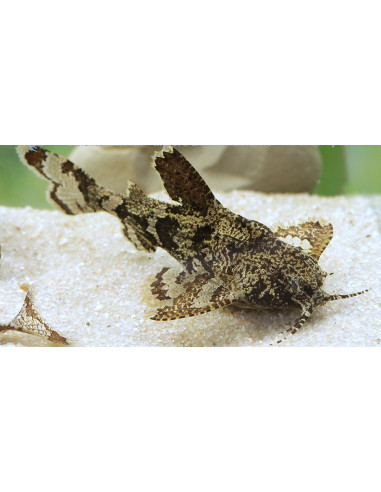
Hara jerdoni 1.2–1.5 cm Wild (Hara jerdoni), also known as the dwarf anchor catfish or Asian stone catfish, is a very small bottom-dwelling catfish from India and Bangladesh. Our specimens are wild-caught and measure 1.2–1.5 cm; as adults they reach about 3–4 cm. They belong to our freshwater range and are ideal for quiet, planted tanks with cooler water.
Hara jerdoni is extremely peaceful, slow and discreet, with a mainly crepuscular/nocturnal lifestyle. The fish usually sit motionless on the sand, among leaves or between stones, perfectly camouflaged.
This is a social species: keep a group of at least 6 fish so they feel secure. A tank of 40–50 litres is sufficient for a small group, provided it is well filtered, very well oxygenated and has only a gentle flow. Avoid boisterous or aggressive tankmates. Use starter bacteria when cycling the tank and monitor the water values with our water tests. This species does not do well in newly set-up, unstable aquariums.
As a small benthic micro-predator, Hara jerdoni feeds on tiny invertebrates and food particles on the bottom. In the aquarium it accepts sinking micro-pellets, tablets for bottom fish and finely chopped frozen foods (brine shrimp, daphnia, bloodworms, mysis).
For best results, feed at dusk or after lights out, placing the food directly on the substrate so the fish can calmly search for it. Vary the diet using our foods for bottom fish, in small portions to avoid excess waste.
This hill-stream species prefers cool, clean and well-oxygenated water. Before adding the fish, treat tap water with an appropriate water conditioner. Provide efficient but not overly strong filtration and maintain the tank with suitable maintenance tools and weekly water changes. Avoid nitrite spikes and long-term high nitrate levels.
Try to recreate a slow hill stream: a bottom of fine sand or very smooth gravel, pebbles, driftwood, leaf litter (e.g. catappa) and clumps of live plants.
Provide plenty of hiding places at the bottom (gaps between stones, piles of leaves, roots) where the fish can rest. A moderate lighting system suits this shy, twilight species very well. Add a few stable decorations without sharp edges.
| Scientific name | Hara jerdoni |
|---|---|
| Adult size | 3 – 4 cm |
| Origin | India, Bangladesh (cool streams and quiet zones) |
| Temperature | 20 – 25 °C |
| pH | 6.0 – 7.5 |
| GH | 3 – 15 °dGH |
| KH | 2 – 8 °dKH |
| Conductivity | 80 – 300 µS |
| Life expectancy | 4 – 6 years (optimal conditions) |
| Behavior | Very peaceful, reclusive, crepuscular/nocturnal, best kept in groups |
| Swimming zone | Bottom |
| Minimum volume | 40–50 L (group) |
| Diet type | Benthic micro-predator (sinking foods, small frozen prey) |
For thriving Hara jerdoni Wild, combine a soft sandy bottom, plenty of hiding places and cool, highly oxygenated water.
Stability = success: check your parameters regularly with our water tests and perform small but frequent water changes instead of occasional large ones.
Fish are shipped with great care in insulated, purpose-designed packaging to ensure their safety during transport.
Data sheet
Specific References
Les animaux vivants suivent un protocole de livraison specifique avec expedition controlee et livraison contre signature.
Acclimatez progressivement vos poissons a la temperature et aux parametres de votre aquarium avant introduction.


Cumulez des points a chaque commande et transformez-les en bons de reduction.
Plus vous achetez, plus vous economisez.