
Livraison gratuite en Belgique et frais de port réduits à 4,99€ pour la France à partir de 59€ !

Livraison gratuite en Belgique et frais de port réduits à 4,99€ pour la France à partir de 59€ !

F1 dwarf Mbuna cichlid from Lake Malawi – perfect for a rocky species tank
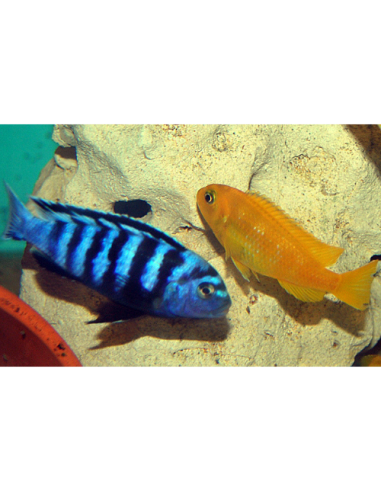
Chindongo saulosi 4–5 cm F1 (Chindongo saulosi) is a dwarf Mbuna cichlid from Lake Malawi, famous for its marked sexual dimorphism: blue males with black bars and yellow females. Our F1 specimens are direct offspring of wild-caught parents, offering natural colouration and behaviour. They belong to our freshwater range and are best suited to a rocky Malawi species aquarium with strong filtration, for knowledgeable, experienced aquarists.
This is a territorial Mbuna, generally somewhat less aggressive than the most combative species, but still a cichlid with a strong temperament. Chindongo saulosi is a social fish that should be kept in a group of 10–12 individuals or more to spread aggression. A harem-style group with more females than males works best.
For a group, we recommend at least 200 liters, with a rock-heavy layout (piles of stones, caves, crevices) and a sandy substrate. Powerful, well-oxygenated filtration is essential, supported by starter bacteria and regular monitoring with water tests.
To preserve the purity of the F1 strain, avoid mixing this species with other cichlids displaying a very similar pattern to reduce the risk of hybridisation. Choose tankmates among other compatible Mbuna of similar size and temperament.
Chindongo saulosi is a typical herbivore/aufwuchs grazer, feeding on algae and micro-organisms growing on rocks. Provide a base diet of spirulina-rich flakes and pellets formulated for herbivorous cichlids, supplemented with small portions of blanched vegetables (courgette, spinach, peas).
Strongly limit rich animal protein (bloodworms, fatty meat, etc.) as this can promote “Malawi bloat”. Vary the menu using our specialised foods and feed several small meals per day, avoiding overfeeding.
Aim for water similar to that of the African Great Lakes: hard, alkaline and very stable. Before adding the fish, treat tap water with an appropriate water conditioner. Use a strong filtration system with good surface agitation and maintain the tank with suitable maintenance tools and weekly water changes.
The species is sensitive to high nitrate levels and sudden changes in water chemistry, so prefer regular water changes (25–40 % per week) and a consistent maintenance routine.
Use a fine aquarium substrate (light sand) and plenty of rocks to recreate a typical rocky Lake Malawi habitat. With aquascaping hardscape (stones, modular structures) you can build caves, hiding spots and clearly separated territories.
Plants are optional; if desired, use robust species such as Anubias or Microsorum attached to rocks. Complete the setup with appropriate decorations and an adequate lighting system that encourages a thin, natural layer of algae on the rocks.
| Scientific name | Chindongo saulosi |
|---|---|
| Adult size | 6 – 8 cm (female), 8 – 10 cm (male) |
| Origin | Lake Malawi (East Africa) |
| Temperature | 24 – 27 °C |
| pH | 7.6 – 8.5 |
| GH | 8 – 20 °dGH |
| KH | 6 – 12 °dKH |
| Conductivity | 250 – 500 µS |
| Life expectancy | 6 – 10 years (optimal conditions) |
| Behavior | Territorial Mbuna, group-dwelling, best in a rocky Malawi tank |
| Swimming zone | Middle / bottom, among the rocks |
| Minimum volume | 200 L (group) |
| Diet type | Herbivore/aufwuchs grazer (algae, plant matter, “green” cichlid foods) |
With F1 fish you benefit from natural colours and behaviour: combine a sufficiently large group, a dense rock layout and a fibre-rich, plant-based diet to minimise stress and avoid issues such as “Malawi bloat”.
Stability = success: monitor pH, hardness and nitrate levels with our water tests and adjust your water change routine accordingly.
Fish are shipped with great care in insulated, purpose-designed packaging to ensure their safety during transport.
Les animaux vivants suivent un protocole de livraison specifique avec expedition controlee et livraison contre signature.
Acclimatez progressivement vos poissons a la temperature et aux parametres de votre aquarium avant introduction.


Cumulez des points a chaque commande et transformez-les en bons de reduction.
Plus vous achetez, plus vous economisez.