
Livraison gratuite en Belgique et frais de port réduits à 4,99€ pour la France à partir de 59€ !

Livraison gratuite en Belgique et frais de port réduits à 4,99€ pour la France à partir de 59€ !

South American sand-sifting cichlid for large, well-filtered aquariums
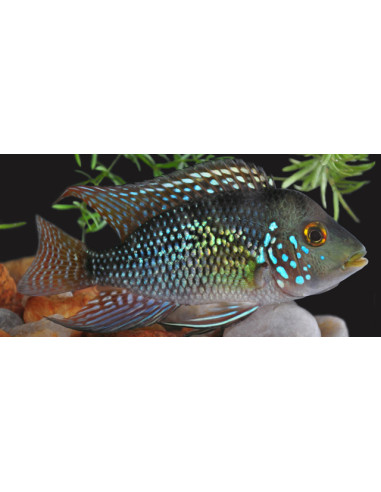
Geophagus brasiliensis 5–6 cm (Geophagus brasiliensis), commonly known as the pearl cichlid, is a robust sand-sifting cichlid from South America. Our fish are juveniles of 5–6 cm; adults typically reach 20–25 cm. This species belongs to our freshwater range and is best suited to spacious, well-filtered aquariums with a fine sand substrate for natural sifting behaviour.
Geophagus brasiliensis is territorial, especially when breeding. It constantly turns over the substrate in search of food, moving sand and small decor items. Adults often form stable pairs that defend a sizeable territory.
We recommend at least 250 litres for a pair, with more volume for groups or community setups. Provide strong filtration, good oxygenation and plenty of hiding places to break lines of sight. Use starter bacteria when cycling and monitor water values with our water tests. Do not mix with very small fish that may be viewed as prey.
This species is an omnivore with a strong insectivorous tendency, sifting sand to find invertebrates, small crustaceans and plant matter. In the aquarium it readily accepts sinking pellets, cichlid sticks, frozen foods (brine shrimp, krill, mussel, daphnia) and some vegetable content.
For optimal condition, vary the diet using our foods for omnivorous cichlids and feed 2–3 small meals per day. Ensure a portion of the food reaches the substrate to encourage natural sand-sifting behaviour.
Although hardy, this cichlid is still sensitive to nitrite spikes. Before adding the fish, treat tap water with an appropriate water conditioner. Provide filtration sized to the bioload and maintain the tank with our maintenance tools and regular weekly water changes.
Recreate a South American river habitat with a fine sand substrate (essential for sifting) and stable rocks and driftwood forming territories and hiding places.
Plants should be well rooted or attached (Anubias, Microsorum, plants on wood), as these cichlids frequently disturb the substrate. A moderate lighting system and a selection of hardy plants complete the layout.
| Scientific name | Geophagus brasiliensis |
|---|---|
| Adult size | 20 – 25 cm |
| Origin | Brazil, Uruguay (rivers and lagoons) |
| Temperature | 20 – 26 °C |
| pH | 6.5 – 7.8 |
| GH | 5 – 20 °dGH |
| KH | 3 – 12 °dKH |
| Conductivity | 100 – 500 µS |
| Life expectancy | 8 – 10 years (optimal conditions) |
| Behavior | Territorial, sand-sifting, pair-forming, may prey on small fish |
| Swimming zone | Bottom and lower midwater |
| Minimum volume | 250 L (pair) |
| Diet type | Omnivore with insectivorous tendency (pellets, frozen foods, vegetable supplements) |
For healthy Geophagus brasiliensis, provide a deep sand bed for sifting, solid rock and wood structures and a varied, protein-rich yet partly vegetable diet.
Stability = success: check your water values regularly with our water tests and adjust water-change frequency to the size and appetite of your cichlids.
Fish are shipped with great care in insulated, purpose-designed packaging to ensure their safety during transport.
Data sheet
Specific References
Les animaux vivants suivent un protocole de livraison specifique avec expedition controlee et livraison contre signature.
Acclimatez progressivement vos poissons a la temperature et aux parametres de votre aquarium avant introduction.


Cumulez des points a chaque commande et transformez-les en bons de reduction.
Plus vous achetez, plus vous economisez.