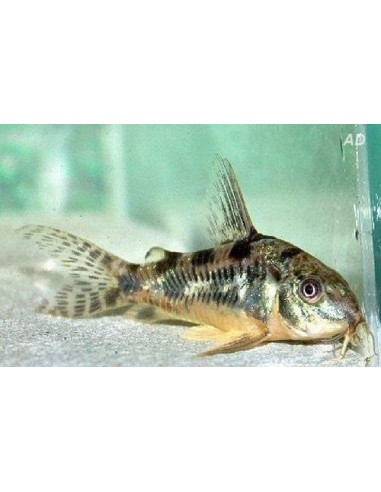
Corydoras Paleatus 2,5-3cm
search
  • Corydoras Paleatus 2,5-3cm

Corydoras Paleatus 2,5-3cm

€3.72
VAT included

Volume discounts

Quantity Unit discount You Save
3 3% €0.33
5 5% €0.93
10 5% €1.86
Quantity

  Garanties sécurité

(à modifier dans le module "Réassurance")

  Politique de livraison

(à modifier dans le module "Réassurance")

  Politique retours

(à modifier dans le module "Réassurance")

Corydoras paleatus(Corydoras paleatus)

A robust and peaceful Peppered Corydoras for community backyard aquariums

The Corydoras paleatus, often called the Peppered Corydoras, is one of the best-known and most robust of the Corydoras. Peaceful, active at the bottom of the tank and very sociable, it is ideally suited to community aquariums, even for novice aquarists with a well-maintained tank.

Origin & habitat

This species is native toSouth America (Argentina, Uruguay, Brazil), where it is found in rivers, streams, flooded areas and shallow pools. It mainly frequents sandy-muddy bottoms with dead leaves, roots and aquatic vegetation, in cool to temperate, well-oxygenated water of varying softness and pH depending on the locality.

Description & sexual dimorphism

  • Adult size: around 5-6 cm
  • Lifespan: 5 to 8 years in good conditions
  • Body: typical of corydoras, stocky with a short head and an inferior mouth with barbels.
  • Colouring: beige to grey with dark mottling giving a peppery appearance, sometimes with a metallic sheen
  • Fins: generally translucent to lightly tinted, sometimes with discreet mottling.

Sexual dimorphism is fairly clear in adults: females are larger and rounder when viewed from above, while males are slimmer and slightly smaller.

Recommended water parameters

  • Temperature: 20-25°C (tolerates a little cooler than many other corydoras)
  • pH: 6.0-7.8
  • Hardness: 2-15 °dGH (soft to moderately hard water)
  • Water quality: clean, well-oxygenated water, no nitrites and low nitrates

Despite its reputation as a hardy fish, the Corydoras paleatus does not tolerate pollution peaks. Regular water changes (20-30% per week) and good filtration are essential.

Aquarium maintenance

  • Minimum recommended volume: 100 litres or more, with a good surface area.
  • Substrate: fine, non-sharp sand (such as Loire sand) to protect their barbels.
  • Decor: roots, leaves, smooth stones, low plants and shaded areas
  • Filtration: effective, but without too strong a current at the bottom
  • Lighting: moderate, subdued by floating plants if possible

Avoid angular gravel, which damages the barbels and encourages infection. Leave large areas of sand free to let them explore the bottom as they please.

Behaviour & cohabitation

Corydoras paleatus is a gregarious fish that should be kept in groups of at least 6-8 individuals, ideally more. In groups, they are more active, less stressed and much more interesting to observe.

  • Character: very peaceful, non-aggressive, suitable for most calm community aquariums.
  • Habitat: bottom of tank, sometimes lower third of water column.
  • Ideal mates: small characids, rasboras, calm viviparous fish, other corydoras, small loricarids.
  • Avoid: large cichlids, territorial or very restless species, bottom predators.

They spend their time searching the substrate, resting together and exploring every nook and cranny, bringing a great deal of life to the bottom zone.

Diet

Omnivorous with a tendency to micropredation, Corydoras paleatus feed mainly on the bottom of the tank:

  • Bottom pellets: good quality tablets and sinking granules.
  • Frozen/live: artemia, daphnia, bloodworms (in moderation), various larvae.
  • Supplements: small portions of finely poached vegetables (courgette, cucumber) from time to time.

They should not be considered as simple 'cleaners': it is essential to feed the bottom specifically, especially if the tank is home to fast-moving open-water fish.

Aquarium reproduction

Corydoras paleatus is relatively easy to breed and often successful in domestic aquariums. It is a substrate-laying fish that adopts the mythical " T-shaped behaviour " when spawning.

  • Breeding tank: small dedicated tank with fine sand, plants and/or spawning mops.
  • Trigger: cooler water changes simulating the rainy season, diet rich in live/frozen food.
  • The female glues the eggs to windows, plants or decor; the adults may eat them.
  • It is advisable to remove the parents or move the eggs to a rearing tank.
  • The fry feed on infusoria, then on freshly hatched artemia nauplia.

Aquabota advice

  • Keep a large group for natural behaviour and reduced stress.
  • Use very fine sand to preserve their barbels and encourage burrowing.
  • Keep the water cool to temperate, clean and well oxygenated.
  • Feed the bottom specifically with suitable pellets and food, especially when fast fish are present.

Quick facts

  • Zoological Name: Corydoras paleatus
  • Common names: peppered corydoras, marbled corydoras
  • Origin: South America (Argentina, Uruguay, Brazil)
  • Adult size: 5-6 cm
  • Swimming zone: bottom
  • Temperature: 20-25°C
  • pH: 6.0-7.8
  • Hardness: 2-15 °dGH
  • Behaviour: gregarious, very peaceful
  • Difficulty level: easy (in a well-maintained tank)

Shipping & Delivery of live fish

Our Corydoras paleatus are prepared with the greatest care in our Aquabota fishroom. Each fish is selected, acclimatised and observed before shipping to ensure optimum health.

  • Packaging: oxygenated bags, insulated in crates specially designed for transporting live fish.
  • Transport: express delivery via specially adapted carriers, to keep time spent in transit to a minimum.
  • Temperature: addition of heaters or ice packs depending on the season, to maintain a stable temperature.
  • Arrival: an Aquabota acclimatisation guide accompanies you step by step to help you introduce your fish in the best possible conditions.

If you have any questions before or after placing your order, our Aquabota team will be happy to advise you on compatibility with your population, the choice of decor and the ideal parameters for your Corydoras paleatus.

V1453530
6 Items

Data sheet

categorie
Poissons tropicaux
origine
Élevés en captivité
espece
Poissons-chats cuirassés
nom latin
Corydoras Paleatus 2,5-3cm
Famille Biotope
Callichthyidé (Amérique du Sud)
Taille adulte
6–7 cm
Volume minimum du bac
80 L
Zone de vie
Fond
Comportement
Paisible
Régime alimentaire
Omnivore
Température
20–24 °C
pH
6.0–7.5
GH
2–12 °dGH
KH
1–8 °KH
Origine géographique
Argentine / Uruguay
Reproduction
Ovipare
Espérance de vie
5–8 ans
Sexe
Mix
Niveau de difficulté
Débutant
Compatibilité
Poissons calmes

Specific References

EAN13
8715897053009
Comments (0)
No customer reviews for the moment.