• Out-of-Stock
Corydoras Habrosus 1-1,5cm Wild
search
  • Corydoras Habrosus 1-1,5cm Wild

Corydoras Habrosus 1-1,5cm Wild

€4.96
VAT included

Volume discounts

Quantity Unit discount You Save
3 3% €0.45
5 5% €1.24
10 5% €2.48
Quantity
Out-of-Stock

  Garanties sécurité

(à modifier dans le module "Réassurance")

  Politique de livraison

(à modifier dans le module "Réassurance")

  Politique retours

(à modifier dans le module "Réassurance")

Corydoras habrosus 1-1,5cm Wild(Corydoras habrosus)

Small wild dwarf corydoras for community backwater aquariums

The Corydoras habrosus is a dwarf corydoras particularly appreciated for its small size, peaceful behaviour and constant activity at the bottom of the tank. The specimens shown here come from the wild and measure around 1-1.5 cm, making them young animals that should be carefully acclimatised in a well-stabilised aquarium.

Origin & habitat

This species is native toSouth America, mainly the flood plains and small tributaries of theOrinoco basin and neighbouring regions (Colombia, Venezuela). It is found in shallow, often calm waters with very slow currents, with a sandy-silt substrate, dead leaves, roots and aquatic or palustrine vegetation. The water is fresh, slightly acidic to neutral and well oxygenated.

Description & sexual dimorphism

  • Sales size: 1-1.5 cm (young, wild)
  • Adult size: around 2.5-3 cm
  • Lifespan: 4 to 5 years in good conditions
  • Body: stocky, typical of dwarf corydoras, with short head and downturned mouth
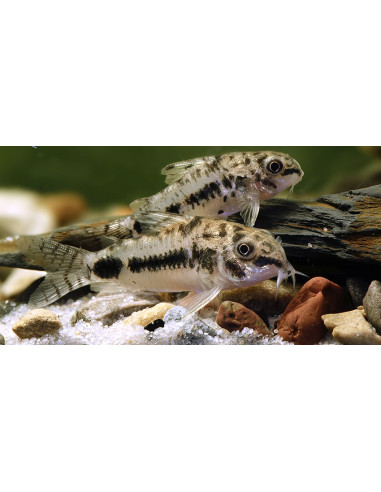
  • Colouring: cream to beige with brown/grey mottled patterns and irregular spots, discreet but very cute in groups.
  • Barbels: fine and sensitive, used to search the substrate for food.

Sexual dimorphism is not very marked in juveniles. In adults, females are generally rounder and slightly larger than males, especially when viewed from above.

Recommended water parameters

  • Temperature: 22-27°C
  • pH: 6.0-7.5
  • Hardness: 2-12 °dGH (soft to moderately hard water)
  • Water quality: very low nitrite and nitrate levels, good oxygenation

Corydoras habrosus, especially small wild ones, are sensitive to pollution peaks and sudden variations in parameters. A mature, well-filtered tank and regular water changes (20-30% per week) are strongly recommended.

Aquarium maintenance

  • Minimum recommended volume: from 60-80 litres for a good group, with a good floor surface area.
  • Substrate: very fine, non-sharp sand (such as Loire sand), essential for preserving their barbels
  • Decor: dead leaves, roots, small smooth stones, moss and low plants to create hiding places
  • Filtration: gentle, with a moderate current, directed spouts to avoid excessive turbulence at the bottom
  • Lighting: low to moderate, areas of shade appreciated

Avoid coarse or sharp substrates (angular gravel), which can damage their barbels, open the way to infections and greatly reduce their life expectancy.

Behaviour & cohabitation

Corydoras habrosus is a gregarious, extremely peaceful bottom-dwelling fish. It needs to be kept in groups of at least 8 to 10 individuals, ideally more, to feel secure and adopt a natural behaviour.

  • Character: calm, non-aggressive, very social with its fellow fish.
  • Habitat: bottom of tank, where it spends its time digging in the substrate.
  • Ideal mates: small characids, rasboras, microfish, dwarf shrimps, other dwarf corydoras, small loricarids.
  • Avoid: large fish, aggressive or very agitated species, predatory cichlids, large burrowing fish.

In groups, they form a very pretty procession on the ground, sometimes resting together on leaves or decorations.

Diet

Omnivorous with a tendency to micropredation, Corydoras habrosus feeds mainly on the bottom:

  • Bottom pellets: pellets and sinking micro-granules of good quality.
  • Frozen / live: artemia, daphnia, mud worms (in moderation), micro-worms, very popular.
  • Complements: small portions of finely poached vegetables (courgette, cucumber) as a supplement, without excess.

Be careful, these are not simple "cleaners": they need to be fed specifically. Distribute food that reaches well to the bottom, especially in the presence of live fish in open water.

Breeding in an aquarium

Reproduction is possible, although it is more delicate with wild fish. It is a substrate-laying fish: the female glues eggs to glass, plants or decorations.

  • Dedicated tank: small breeding tank with fine sand and soft, slightly acidic water.
  • Trigger: cooler water changes simulating the rainy season, rich live/frozen food.
  • Adults may eat the eggs: plan to remove them or move the eggs.
  • The fry should be fed with infusoria, followed by freshly hatched artemia.

Aquabota advice

  • Prepare a well-cycled tank before introducing these young 1-1.5 cm wild fish.
  • Use very fine sand and avoid sharp gravel to protect their barbels.
  • Keep them in large groups to reduce stress and encourage natural behaviour.
  • Avoid overly lively or aggressive roommates who could intimidate them at the bottom.

Quick facts

  • Zoological Name: Corydoras habrosus
  • Origin: South America (Orinoco basin and surrounding areas)
  • Status: Wild
  • Purchase size: 1-1.5 cm
  • Adult size: 2.5-3 cm
  • Swimming zone: bottom
  • Temperature: 22-27°C
  • pH: 6.0-7.5
  • Hardness: 2-12 °dGH
  • Behaviour: gregarious, very peaceful
  • Difficulty level: intermediate (young wild fish requiring careful acclimatisation)

Shipping & Delivery of live fish

Our Corydoras habrosus Wild are prepared with the greatest care in our Aquabota fishroom. Each fish is selected, acclimatised and observed before dispatch to ensure optimum health, which is particularly important for young wild fish.

  • Packaging: oxygenated bags insulated in crates specially designed for transporting live fish.
  • Transport: express delivery via specially adapted carriers, to keep time spent in transit to a minimum.
  • Temperature: addition of heaters or ice packs depending on the season, to maintain a stable temperature.
  • Arrival: an Aquabota acclimatisation guide accompanies you step by step to help you introduce your fish in the best possible conditions.

If you have any questions before or after placing your order, our Aquabota team is on hand to advise you on compatibility with your population, ideal parameters and acclimatisation of wild Corydoras habrosus.

V1453363

Data sheet

categorie
Poissons tropicaux
origine
Capturés dans la nature
espece
Corydoras
nom latin
Corydoras Habrosus 1-1,5cm Wild
Famille Biotope
Callichthyidé (Amérique du Sud)
Taille adulte
3 cm
Volume minimum du bac
40 L
Zone de vie
Fond/Milieu
Comportement
Grégaire
Régime alimentaire
Omnivore
Température
22–26 °C
pH
6.0–7.5
GH
2–12 °dGH
KH
1–8 °KH
Origine géographique
Venezuela / Colombie
Reproduction
Ovipare
Espérance de vie
4–6 ans
Sexe
Mix
Niveau de difficulté
Débutant
Compatibilité
Poissons nains calmes

Specific References

EAN13
8715897211362
Comments (0)
No customer reviews for the moment.