
Livraison gratuite en Belgique et frais de port réduits à 4,99€ pour la France à partir de 59€ !

Livraison gratuite en Belgique et frais de port réduits à 4,99€ pour la France à partir de 59€ !
Reference V1454005
Description detaillee : ici >

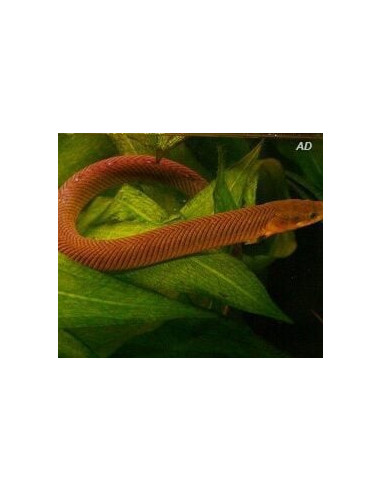
Wild rope fish (reedfish) for large, securely covered aquariums
Erpetoichthys calabaricus 12–15 cm Wild (Erpetoichthys calabaricus), commonly known as the rope fish or reedfish, is a long, mostly nocturnal predator from West and Central Africa. Our specimens are wild-caught and measure 12–15 cm; as adults they usually reach 35–45 cm. They belong to our freshwater range and are suitable only for large, well-equipped aquariums with a tight-fitting cover.
This is a calm but predatory species with a mainly crepuscular/nocturnal lifestyle. It spends most of its time near the bottom, weaving through roots and hiding places. Adults are generally peaceful towards each other, but small tankmates that fit in the mouth will be eaten (tiny rasboras, fry, small shrimps, etc.).
We recommend a tank of at least 250 litres for a small group (2–3 fish), preferably long and spacious, with strong filtration and a perfectly secure lid without gaps around hoses, cables or filters – rope fish are expert escape artists. Use starter bacteria when cycling the tank and monitor the water values with our water tests. Although they can gulp air at the surface, they still appreciate a gentle, steady flow and decent oxygenation.
Erpetoichthys calabaricus is an opportunistic carnivore feeding on worms, insects, crustaceans and small fish. In the aquarium it readily accepts frozen foods (brine shrimp, krill, mussel, pieces of fish, bloodworms), sinking pellets and sticks for carnivores and, if desired, some live foods (worms, appropriate feeder fish).
Feed mainly in the evening, close to the bottom, making sure the rope fish actually get their share. For best condition, vary the diet using our foods for carnivorous fish. Avoid relying on tiny foods or floating flakes that are quickly eaten by midwater fish.
This robust species is still sensitive to nitrite spikes, especially shortly after introduction. Before adding the fish, treat tap water with an appropriate water conditioner and provide filtration sized to the tank volume. Maintain the aquarium using suitable maintenance tools and regular weekly water changes.
Try to recreate an African swamp or backwater habitat: a sandy or fine substrate, lots of roots and branches, tubes and caves, leaf litter (e.g. catappa) and robust live plants (Anubias, Crinum, Bolbitis…). Provide generous shaded areas where the fish can hide during the day.
A moderate lighting system, possibly softened by floating plants, suits this nocturnal species very well. Avoid sharp decorations that could damage their long, scaleless body.
| Scientific name | Erpetoichthys calabaricus |
|---|---|
| Adult size | 35 – 45 cm |
| Origin | West and Central Africa (swamps, marshes, calm backwaters) |
| Temperature | 24 – 30 °C |
| pH | 6.2 – 7.8 |
| GH | 3 – 15 °dGH |
| KH | 2 – 10 °dKH |
| Conductivity | 80 – 400 µS |
| Life expectancy | 10 – 15 years (optimal conditions) |
| Behavior | Calm, nocturnal, opportunistic predator of small fish |
| Swimming zone | Bottom / lower midwater |
| Minimum volume | 250 L (small group) |
| Diet type | Carnivore (frozen/live prey, sinking carnivore pellets) |
For successful keeping of Erpetoichthys calabaricus, combine a 100% escape-proof cover with plenty of bottom hiding places and a protein-rich evening feeding routine.
Stability = success: check your parameters regularly with our water tests and maintain a consistent schedule of water changes to keep your rope fish in top condition.
Fish are shipped with great care in insulated, purpose-designed packaging to ensure their safety during transport.
Data sheet
Specific References
Les animaux vivants suivent un protocole de livraison specifique avec expedition controlee et livraison contre signature.
Acclimatez progressivement vos poissons a la temperature et aux parametres de votre aquarium avant introduction.


Cumulez des points a chaque commande et transformez-les en bons de reduction.
Plus vous achetez, plus vous economisez.